salakhalimunmountain.com – Climbing high along the knife-edge ridges of Mount Salak is one of the most exhilarating experiences West Java has to offer. As you push above the dense rainforest canopy, the trail narrows into single-track spines flanked by sheer green ravines on either side. Cool mountain winds sweep across the exposed ridges, offering breathtaking panoramas of surrounding valleys and distant volcanic peaks. However, navigating these relentless high-elevation ascents demands tremendous endurance. When every step takes you higher up a steep, narrow incline, learning how to conserve your physical energy becomes crucial. Mastering the rest step on Mount Salak ridges is the ultimate technique for maintaining a steady pace without burning out your legs.
To an inexperienced hiker, ascending a long, steep ridge can quickly become a cycle of heavy sprinting followed by total exhaustion. You push hard for a few dozen steps, feel your heart rate skyrocket and your quadriceps burn with lactic acid, and then collapse onto a rock to catch your breath. Repeating this stop-and-go pattern drains your stamina rapidly and increases muscle fatigue, making your footing unstable on narrow ridge crests. In contrast, local guides move up steep mountain spines with a quiet, uninterrupted rhythm. They use the rest step—a classic mountaineering technique that transfers your body weight onto your skeletal frame between strides—allowing you to climb for hours with minimal muscle fatigue.
The Physiology of the Rest Step: Bones Over Muscles
To understand why the rest step is so effective on steep ridge climbs, it helps to look at how your body carries weight. When you walk normally on flat ground, your leg muscles remain continuously engaged to balance and propel you forward. As the incline steepens past twenty or thirty degrees, your quadriceps, calves, and hamstrings must work significantly harder to lift your body weight and backpack upward against gravity.
Muscles rely on oxygen and stored glycogen to contract. When forced to work continuously without pause, they accumulate metabolic waste products like lactic acid, leading to that familiar, burning sensation and muscle quivering. Bones, on the other hand, require zero chemical energy to support weight. The fundamental principle of the rest step is to pause for a fraction of a second on a locked rear leg with every stride, allowing your bone structure to take the load while your lead leg muscles completely relax.
How a Micro-Pause Resets Your Leg Muscles
The rest step relies on a precise, rhythmic sequence. As you step forward onto a steep incline, extend your rear leg fully until the knee locks momentarily in a straight, stable position. Transfer your entire body weight onto this straight rear leg, letting your femur and tibia form a solid vertical pillar directly beneath your hip.
While your rear leg carries your weight on locked bone structure, your lead foot rests lightly on the slope ahead without engaging its muscles yet. In this brief micro-pause—lasting anywhere from half a second to a full second—the muscles in your lead leg receive a moment of complete rest. Blood flows freely through the relaxed muscle tissue, clearing out metabolic waste and replenishing oxygen before your next step. By repeating this micro-pause with every single stride, you give your muscles hundreds of tiny breaks every few minutes.
Adapting the Rest Step to Narrow Salak Ridges
While the rest step was originally developed on alpine snow slopes, adapting it to the narrow, rocky, and root-strewn ridges of Mount Salak requires specific adjustments. Tropical mountain ridges do not offer smooth, predictable staircases. You are constantly negotiating exposed tree roots, loose volcanic gravel, slick clay patches, and narrow rock ledges where foot placement must be precise.
When executing the rest step on a Salak ridge, focus on landing your lead foot flat on whatever micro-shelf is available. Avoid stepping high on your toes, as this forces your calf muscles to stay flexed during the pause. Instead, aim to place your heel down on a sturdy root loop, a flat basalt ledge, or a pocket of firm earth. Planting a flat foot creates a stable base that lets you lock your rear knee with complete confidence.
Shortening Your Stride on Steep Terrain
A common error when climbing steep ridges is taking long, ambitious strides to gain height quickly. Giant lunges force your lead knee into a deep bend, requiring maximum muscular force from your quadriceps to push your body upward. On a narrow, exposed ridge, taking big steps also compromises your balance and increases the risk of slipping.
Shorten your stride dramatically when applying the rest step on high ridges. Take small, deliberate micro-steps that keep your lead foot directly beneath your center of mass. Small steps require far less muscular effort to complete, allowing your rear leg to lock smoothly into the rest position without forcing your torso to sway or wobble over exposed drop-offs.
Syncing Breathing with Your Climbing Cadence
Physical footwork is only half of the rest step equation; the second crucial component is respiratory synchronization. On high, steep ridges, high exertion can cause rapid, shallow breathing, which leads to hyperventilation and elevated anxiety on exposed terrain. Linking your breathing directly to your rest step cadence keeps your nervous system calm and your cardiovascular system operating efficiently.
Establish a strict 1:1 or 2:1 ratio between your steps and your breath. For instance, inhale deeply through your nose as you step and pause on your left leg, then exhale fully through your mouth as you step and pause on your right leg. On exceptionally steep sections, slow down your tempo and take two full breaths during the micro-pause on each locked leg before taking your next step forward.
Pacing for Long-Haul Ridge Ascents
The rest step is not about speed; it is about relentless, uninterrupted momentum. When using this technique properly, you will move at a pace that might feel surprisingly slow at first. Hikers who rush past you early in the climb will often be forced to stop repeatedly to catch their breath and rest their aching calves.
By maintaining a slow, steady rest step rhythm, you eliminate the need for frequent, lengthy trail stops. You can climb steep ridge sections for hours at a constant, comfortable heart rate. Over the course of a long ascent up Mount Salak, this steady, continuous movement gets you to the summit faster and with far less physical fatigue than a frantic stop-and-go pace.
Gear and Mindset for High-Ridge Confidence
Having the right equipment provides essential support when mastering the rest step on exposed mountain terrain. High-cut or mid-cut trekking boots with stiff midsoles are ideal for ridge climbing. A rigid boot sole supports your arch and heel during the micro-pause phase, preventing foot fatigue when resting on small, narrow rock edges.
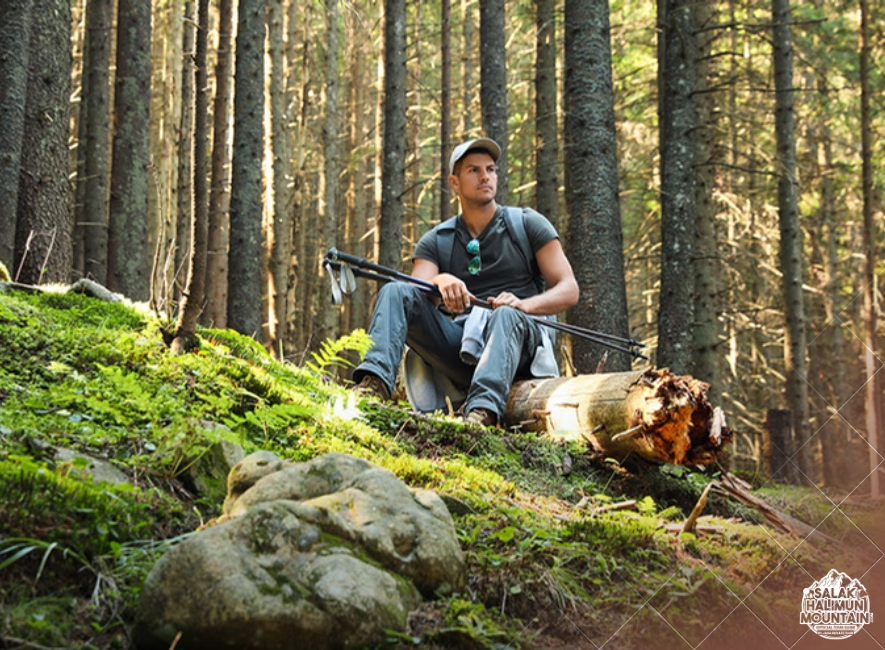
Trekking poles are equally valuable on steep ridge ascents. Plant your poles slightly behind your body at an angle, using them as extra balance pillars while your rear leg locks into the rest position. Pushing down lightly through your pole grips takes additional load off your lower back and legs, providing rock-solid four-point stability along narrow mountain spines.
Cultivating Calm Focus on Exposed Trails
Climbing high ridges requires mental discipline alongside physical technique. Looking down at steep, dropping slopes on either side of the trail can trigger tension in your shoulders and cause your breathing to become shallow. Tension tightens your muscles, making smooth footwork much harder to execute.
Focus your attention entirely on the immediate two feet of trail directly in front of you. Trust the rest step rhythm, keep your breathing deep and rhythmic, and let your bones carry your weight. By staying grounded in the present movement and moving in harmony with the mountain, you transform demanding, steep climbs into an enjoyable, meditative journey along Mount Salak’s majestic high ridges.
So, if you’re ready to explore the wonders of Mount Salak Halimun, head over to our ONLINE BOOKING PAGE and let’s start planning your adventure. Or simply CLICK THIS LINK to chat with us on WhatsApp.
With our team, you’re not just getting a guide; you’re gaining a local friend who will ensure your trip is nothing short of extraordinary.